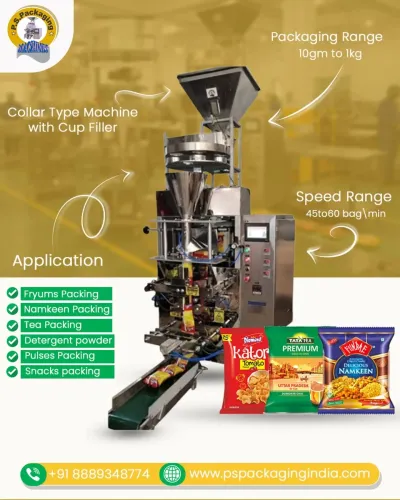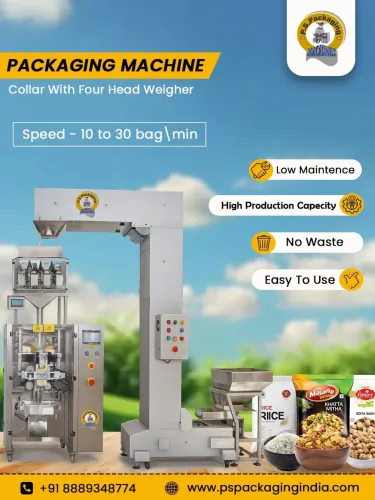

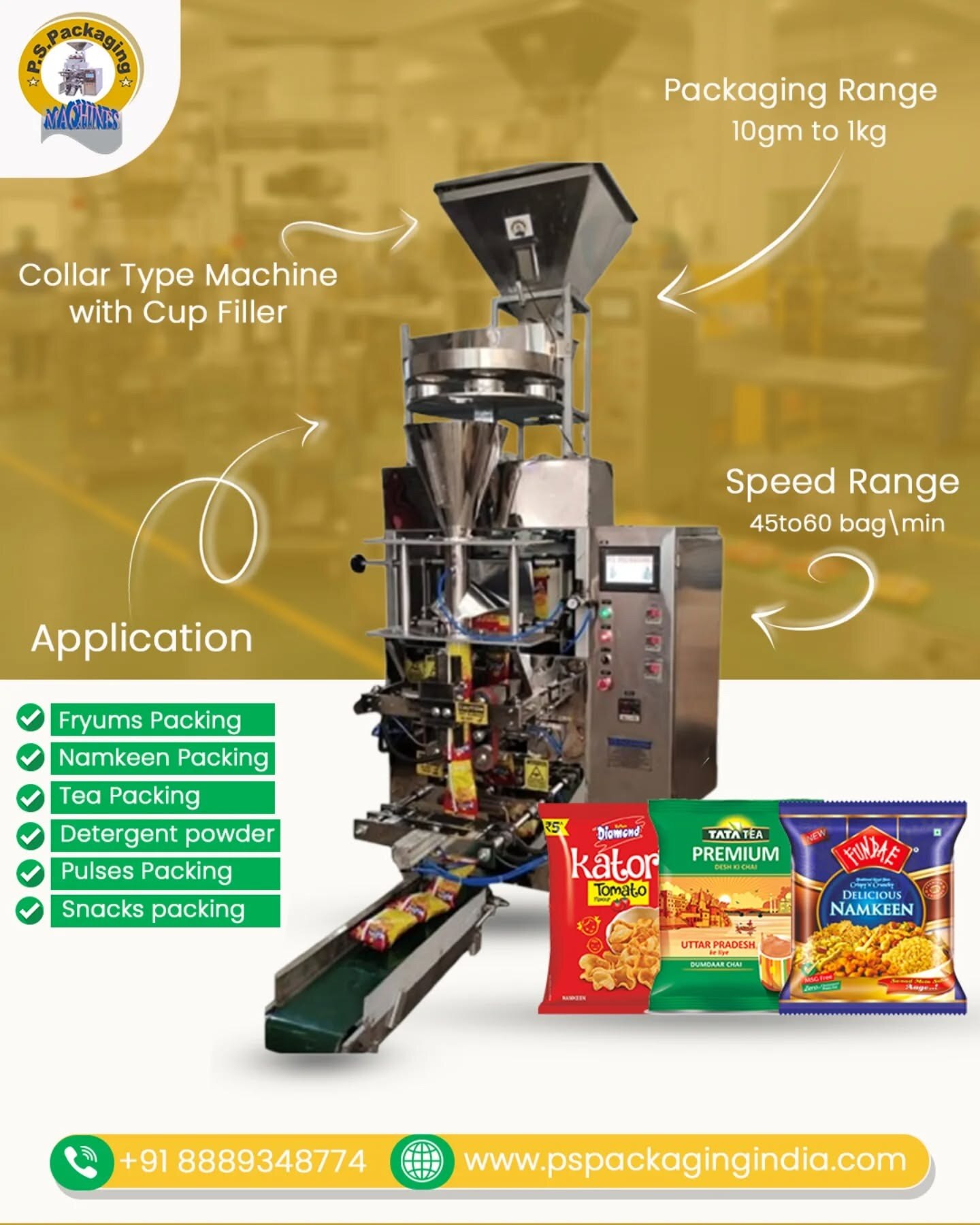
A four-head collar machine combines a dosing system with a vertical form-fill-seal line, but “four head” does not automatically mean four pouches per cycle or a fixed production speed. By matching the feeder, film, pouch dimensions, utilities and acceptance tests to your product, you can compare equipment on usable output, weight control and operating effort rather than on a headline claim.
Key takeaways
- Four heads feed one pouch-forming tube, not four separate pouch lanes.
- Choose weighers, augers, volumetric cups or pumps for the product.
- Check pouch dimensions, product flow, air, power and floor space first.
- Demand product trials and an itemised quote before comparing suppliers.
How a four-head collar packing machine forms and fills each pouch
Four heads usually means four weighing or dosing positions feeding one vertical pouch-making tube—not four pouch lanes or four pouches per cycle. The controller draws product from these positions, combines portions to reach the target weight, and releases that charge through the collar-forming tube.
Inside the machine, the operation follows a continuous sequence:
- Product enters the four weighing heads from a hopper, feeder or elevator.
- Load cells measure portions, and the controller selects or combines them against the target weight.
- A film roll unwinds around a forming collar, which folds flat film into a tube.
- A vertical seal closes the film’s lengthwise seam.
- The weighed product drops through the tube into the formed pouch.
- Horizontal jaws seal the top of the filled pouch and the bottom of the next one.
- A knife separates the pouch, which falls onto a conveyor or collection tray.
The four-head layout suits free-flowing grains, pulses, seeds, snacks, pellets and similar products with consistent flow. Powders, sticky materials and fragile irregular pieces can bridge, smear or break, so they need a product-specific feeder and trial.
A 4 head packing machine in Indore does not have one fixed production rate. Usable packs per minute depends on target weight, product flow, pouch dimensions, film, weighing tolerance, sealing time and loading method. Compare suppliers using a trial that records weight variation, rejected packs, changeover time and sustained output—not the headline speed alone.
Match the product to the correct dosing system
A four-head system suits free-flowing, relatively uniform products such as rice, pulses, seeds, snacks, pellets and other granules. The four heads are weighing or dosing stations feeding one collar-forming pouch line, not four separate pouch lanes.
Choose the dosing method by product behaviour:
- Volumetric cups suit dry granules with stable bulk density, such as grains or detergent granules. Select them for simple, repeatable fills where small weight variation is acceptable.
- Augers suit powders such as flour, spices, milk powder and chemical powders. Use an enclosed auger when dust, bridging or inconsistent flow makes cups unreliable.
- Pistons suit liquids and viscous products such as sauces, oils, creams and pastes. Confirm that the product does not separate or clog the filling path.
- A multihead weigher suits free-flowing products with variable piece weight, including snacks, coated nuts and irregular pellets. It combines portions to reach the target weight, improving accuracy but adding cost and cleaning effort.
| Option | Best match | Choose it when |
|---|---|---|
| Volumetric cups | Uniform granules | Density stays consistent |
| Auger | Powders | Controlled screw feeding is needed |
| Piston | Liquids and pastes | Volumetric liquid filling is required |
| Multihead weigher | Variable pieces | Accuracy matters more than basic simplicity |
Nitrogen flushing, checkweighing and multi-lane feeding are separate process choices, not interchangeable dosing systems. Specify the product, target weight and accuracy before comparing four head collar packing or packaging automation solutions in Indore; headline speed alone cannot show usable output.
Compare four heads with other packing system layouts
Four heads sit between a simple single-head line and a high-output 10- or 14-head weigher. They do not mean four pouch lanes: four weighing buckets feed one vertical form-fill-seal tube, so output depends on product, target weight, film, pouch size and sealing time.
| Layout | Output and accuracy | Changeover, space and material |
|---|---|---|
| Single-head | Lowest output, but straightforward dosing and good control for short runs | Smallest footprint and simplest changeover; roll film keeps pouch cost low |
| Four-head weigher | Moderate output with fewer combination choices than 10 or 14 heads; suitable for free-flowing products | Compact and less costly than larger weighers; change film, collar and forming tube for each pouch format |
| 10-head weigher | Higher output and better compensation for piece-weight variation | More floor space, controls and cleaning points; greater capital cost |
| 14-head weigher | Highest combination flexibility among these weighers, supporting speed and target-weight accuracy | Largest footprint and cost; changeovers involve more buckets and product-contact parts |
| Cup filler | Fast and economical for uniform granules, but bulk-density changes affect weight | Simple dosing changeover; fixed-volume tooling limits product and pack-size flexibility |
| Auger filler | Strong choice for powders and controlled dosing, but dust, bridging and screw cleaning add work | Compact feeder, with product-specific screws; not interchangeable with a weigher |
| Premade-pouch machine | Eliminates film forming and can deliver polished pouch presentation, but pouch supply costs more | Stores multiple pouch sizes and needs pouch handling; no roll-film saving |
Compare the quoted four head pouch packing machine price only after adding the weigher, elevator, platform, coder, compressor, nitrogen kit, checkweigher, installation and spares. A roll-film collar line is usually the better fit when you need flexible pouch lengths and controlled material cost; premade pouches suit branding or shapes a forming tube cannot produce.
Check pouch, product, utility and space requirements before ordering
Fit depends on the pouch dimensions, product behaviour, film construction and factory utilities—not on the machine’s pack-per-minute claim alone. Specify these details before comparing packaging automation solutions in Indore.
- Confirm target weight, product bulk density, moisture, dust level, particle size and fragility. Free-flowing grains, pulses, seeds and pellets suit four-head weighing; powders, sticky materials and irregular pieces need product-specific dosing trials.
- Match the forming collar, tube diameter, film width, pouch width, pouch length, gusset, seal overlap and cut length. A machine can accept your roll width yet produce the wrong pouch geometry.
- State the film type, film thickness, sealing temperature range and required seal strength. Film that slips, stretches or needs longer dwell time changes the sealing-jaw specification and output.
- Check the electrical supply, connected load, compressed-air pressure and air quality. Ask for consumption figures, not just a statement that air is required.
- Measure clearance for the machine, film-roll access, product loading, discharge conveyor, coding equipment and operator movement.
| Option | Technical effect | Check before ordering |
|---|---|---|
| Nitrogen flushing | Adds gas piping, sensors and modified sealing control | Required residual oxygen level and gas supply |
| Vacuum | Changes product handling, sealing and cycle time | Vacuum level and pack collapse risk |
| Multi-lane feeding | Needs additional feeders, controls and frame width | Lane count, balance and cleaning access |
| Checkweighing | Adds downstream conveyor, reject device and controls | Reject collection and manual intervention |
Define how product reaches the weigher, who changes film rolls, who removes rejects and whether finished pouches need conveying. A line described as automatic can still depend on continuous manual feeding, coding or reject handling.
Use trials and an itemised quote to choose the right supplier
A product trial is the only reliable way to test usable output. Give the collar type packing machine manufacturer in Indore your actual product, target weight, pouch dimensions and production film, then record saleable packs per minute rather than the empty-machine speed claim.
Specify a continuous factory or site acceptance test. Define the run duration, permitted stoppages, target-weight tolerance, rejected-pack limit, seal-integrity test, and changeover time between two pouch sizes.
Measure each decision against evidence:
| Measure | Acceptable evidence | Why it matters |
|---|---|---|
| Usable output | Saleable packs per minute during a continuous run | Includes weighing, sealing and discharge losses |
| Accuracy | Recorded weights from a defined sample, with tolerance stated | A fast machine that gives overweight packs increases product giveaway |
| Changeover | Timed change from one film or pouch size to another | Long setup reduces the shift’s actual capacity |
| Seal quality | Peel, burst or leak checks after the run | Incorrect temperature or pressure creates rejects and returns |
Ask for an itemised quote, not only a four head pouch packing machine price. Require separate lines for the weigher, elevator or feeder, platform, compressor, date coder, nitrogen kit, metal detector, checkweigher, spare forming tubes, installation, taxes, commissioning, training, warranty exclusions and recommended spares.
PS PACKAGING can be compared fairly with another supplier only after both quote the same film specification, sealing temperature range, core and roll dimensions, accessories and acceptance test. A supplier who will not document those conditions has not given you a production cost.
Related product
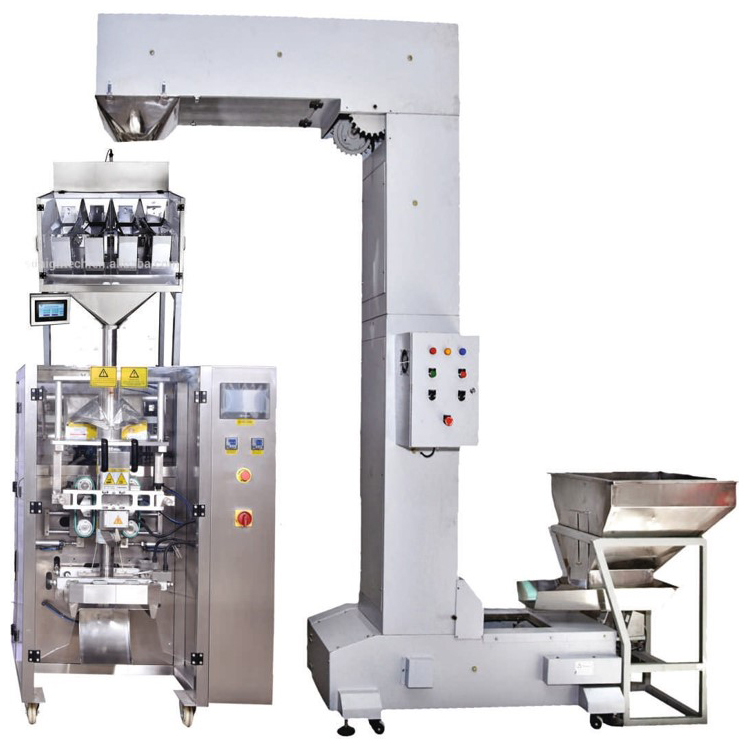 | 4 Head Packing Machine 4 Head Collar Type Packing Machine Manufacturer in Indore, India High-Speed Automatic 4 Head Collar Type Packing Machine by P.S. View product → |
Frequently asked questions
How does a four-head collar packing machine form and fill each pouch?
Four weighing or dosing positions feed one vertical pouch-making tube. The controller combines portions to reach the target weight, then releases the charge through the collar-forming tube.
How do you match the product to the correct dosing system?
Use multihead weighing for free-flowing solids, an auger for powders, volumetric cups for consistent granules, and a pump for liquids or pastes. Confirm accuracy through a product trial.
What should you check before ordering a four-head pouch packing machine?
Confirm pouch material and dimensions, product characteristics, target weight, output, compressed air, electrical supply, headroom, floor area and cleaning access.
Why request trials and an itemised quote from the supplier?
Trials reveal dosing accuracy, sealing performance, speed and product handling. An itemised quote lets you compare the machine, tooling, date coder, conveyors, installation, training and exclusions.