
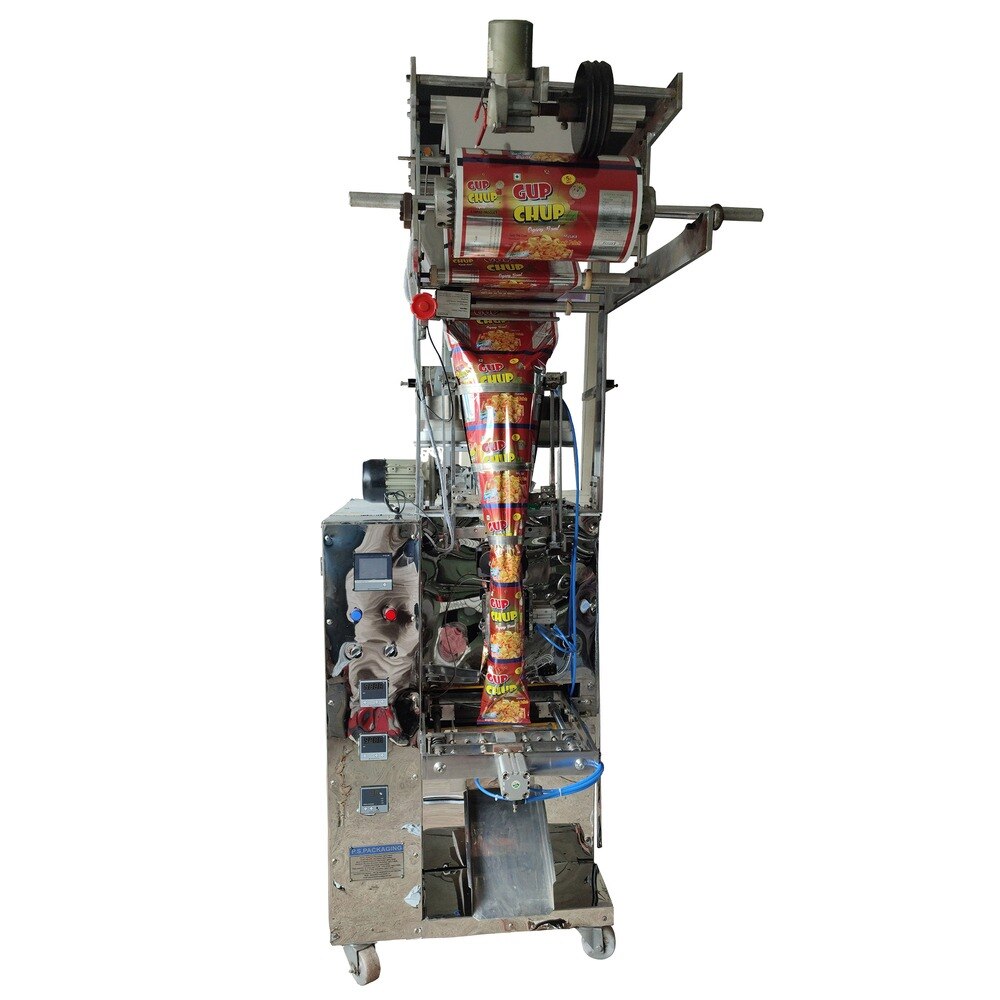
The right machine depends on the namkeen’s density, particle shape, target pack weight, required speed, and tolerance for broken pieces—not simply on whether the equipment is labelled automatic. By the end, you will be able to test cup volume, compare filling systems, define the utilities and hygiene requirements, and evaluate an Indore supplier’s quotation on saleable output rather than advertising claims.
Key takeaways
- Test cup settings at your target weight using the actual namkeen mix.
- Choose cup filling when product flow and volume consistency suit your pack.
- Check air pressure, sealing parts, food-contact materials, and total installed cost.
- Run a product trial with an Indore supplier before approving the machine.
How a pneumatic cup filler measures namkeen—and when it fits
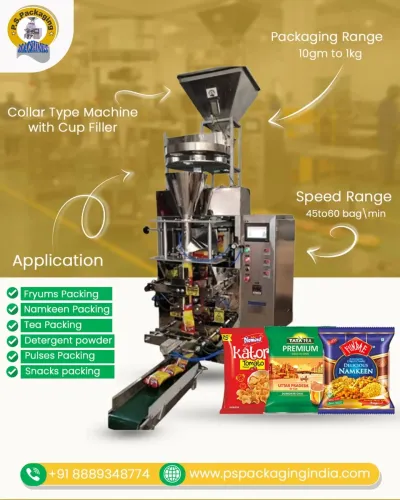
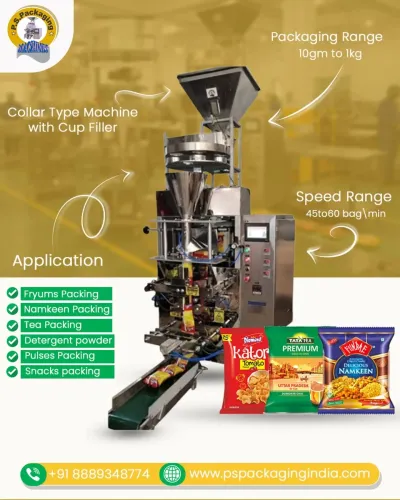
A pneumatic cup filler measures namkeen by volume, not by weight. Adjustable cups beneath the hopper fill to a set level, then a pneumatic gate releases that portion into the pouch; compressed air usually moves the gate, clamps, or sealing parts rather than performing the measurement.
The filler commonly feeds a vertical form-fill-seal machine making pillow pouches.
| Namkeen product | Fit for cup filling | Main concern |
|---|---|---|
| Uniform sev | Strong fit | Bulk density changes can alter net weight |
| Boondi | Strong fit | Control drop height to limit breakage |
| Peanuts | Good fit | Check cup size and product bridging |
| Consistent mixtures | Trial required | Components can separate or settle |
| Irregular fried snacks | Limited fit | Pieces can jam, break, or fill unevenly |
A cup filler works best when the product has stable piece size and bulk density. If the recipe contains several components, density changes between batches, or the target weight must be highly precise, a multihead weigher deserves comparison.
For a search brief such as “pneumatic cup filler namkeen packing machine in Indore,” state the target weights, pouch style, packs per minute, product recipe, acceptable breakage, laminate, available compressed air, coding, and nitrogen requirements. During a trial, inspect the chute and measure fines and broken pieces—not only the displayed pack weight.
Turn the target pack weight into a tested cup setting
Begin with bulk density, not the cup’s label. Divide the target weight in grams by the namkeen’s tested bulk density in grams per cubic centimetre to estimate the required cup volume. For example, 100 g at 0.50 g/cm³ needs about 200 cm³, but settling, particle size, and oil content can change the result.
Use the actual recipe and film during the trial. Follow this sequence:
- Fill the hopper to the intended operating level and run the machine until the cups fill consistently.
- Set the cup near the calculated volume, then weigh 30 consecutive filled pouches.
- Record every weight, calculate the average, and note the lightest and heaviest pouch.
- Adjust the cup volume or fill level, repeat the run, and test each namkeen SKU separately.
A nominal 200 cm³ cup does not guarantee 100 g. A dense peanut mixture and a loose sev mixture occupy different volumes, while vibration and operator adjustments alter cup loading.
| Measurement | What it reveals | Decision |
|---|---|---|
| Average pouch weight | Overall cup setting | Increase or reduce volume |
| Lightest pouch | Risk of underweight packs | Check against your declared-weight tolerance |
| Heaviest pouch | Overfill and giveaway | Reduce variation before increasing speed |
| Broken pieces and fines | Product-path damage | Inspect drop height, gates, and chute |
Ask for pneumatic cup filler machine specifications showing the adjustable cup range, hopper capacity, pouch dimensions, sealing temperature, quoted speed at your pouch size, and changeover time. Accept test results in grams, not only a stated cup volume.
Compare cup filling with auger, single-head, multihead, and manual packing
A pneumatic cup filler gives the best balance for free-flowing namkeen with stable bulk density, such as boondi, fried peas, sev, or simple fried-pulse mixes. Its fixed-volume cup limits handling, so fragile pieces face less damage than with repeated weighing.
The weakness is weight drift: a change in oil, seasoning, moisture, or product density changes the grams in each cup.
| Option | Accuracy and speed | Labour and product protection |
|---|---|---|
| Pneumatic cup filler | Fast for repeatable products; accuracy depends on stable density and correct cup volume | Low labour; gentle, with fewer product drops |
| Auger filler | Precise for powders, not whole or irregular namkeen; speed depends on product flow | Low labour; auger compression can damage pieces and is a poor fit for chunky snacks |
| Single-head weigher | Better weight control across variable-density products, but slower because it weighs each pack sequentially | Moderate labour; controlled handling, yet each weighing cycle adds time |
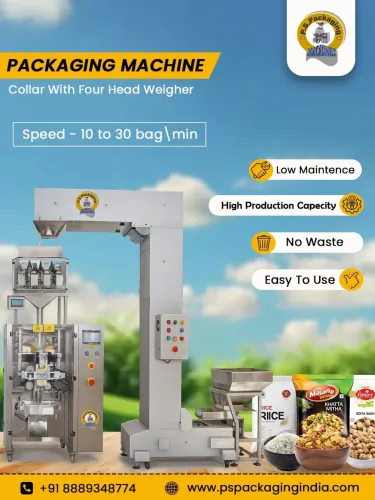
| Multihead weigher | Highest speed and accuracy for varied mixtures; 10-head or 14-head systems cost more | Low labour; multiple drops and vibration can increase breakage in delicate snacks |
| Manual packing | Lowest equipment cost and flexible for short runs | Highest labour and weight variation; handling increases contamination and breakage risk |
Choose the cup filler when saleable speed, simple changeovers, and gentle handling matter more than tight weight control across changing products. Choose a multihead weigher for premium mixed namkeen, frequent recipe changes, or strict giveaway limits. Run the actual product before deciding; controller speed is not saleable packs per minute.
Check air, sealing, food-contact construction, and the complete price
Do not approve a quotation that says only “automatic” or “high speed.” It must state the machine’s tested output, utilities, materials, sealing limits, included accessories, and installed cost for your actual pouch and namkeen.
1. Ask for the pneumatic figures: operating pressure in bar, air consumption in litres per minute, required compressor capacity, air dryer or filter specification, and electrical supply and connected load. Confirm whether the quotation includes the compressor, dryer, regulator, pneumatic valves, sensors, and electrical panel.
Low air pressure can cause incomplete filling, missed cycles, and erratic sealing.
2. Require sealing details: jaw type, sealing temperature range, film width, pouch width and length limits, heater and thermocouple make, date coder provision, and saleable packs per minute at your chosen pack size. A controller’s cycle count is not proof of output; record rejected packs during a trial.
3. Specify food-contact construction by part. Ask for stainless-steel grade for the hopper, cups, chute, and contact surfaces; removable parts; weld finish; and cleaning access. Confirm that fried crumbs and seasoning will not collect around concealed ledges or pneumatic components.
4. Make the namkeen packing machine price fully itemised. It must show the cup filler, VFFS body, change parts, coder, conveyor, nitrogen kit, installation, commissioning, freight, GST, warranty, and operator training separately. Add response time, spare heater and sensor pricing, preventive-maintenance instructions, and technician access before signing.
Evaluate an Indore supplier through a real product trial
Do not approve a machine from a demonstration using the supplier’s product. Ask the namkeen packing machine manufacturer in indore to run your actual sev, boondi, peanuts, mixture, or fried snack in your specified laminate and pouch size.
1. Send a written trial brief with target net weights, pouch style, film structure, pouch length, required packs per minute, acceptable breakage, available power and compressed air, date coding, and nitrogen-flushing requirements.
2. Watch the complete product path. Inspect the hopper, cup, discharge chute, forming collar, and sealing jaws for sharp transitions, excessive drop height, product trapping, and seasoning buildup. Collect fines and broken pieces separately.
3. Weigh at least 20 consecutive saleable pouches at the intended setting. Record average weight, lightest and heaviest pouch, rejected packs, seal temperature, film tracking, and actual saleable packs per minute. Do not accept the controller’s cycle count as output.
4. Repeat the run after a size change and a controlled stop. This exposes changeover time, cup-setting difficulty, operator dependence, and restart faults.
5. Ask who will commission the machine in Indore, how quickly they stock pneumatic valves, sensors, heaters, and forming collars, and whether a technician can visit your plant. Obtain preventive-maintenance instructions and escalation contacts in writing.
PS PACKAGING should be judged by the same evidence: your product, your laminate, recorded results, and the complete installed scope—not its local address or advertised speed.
Related products
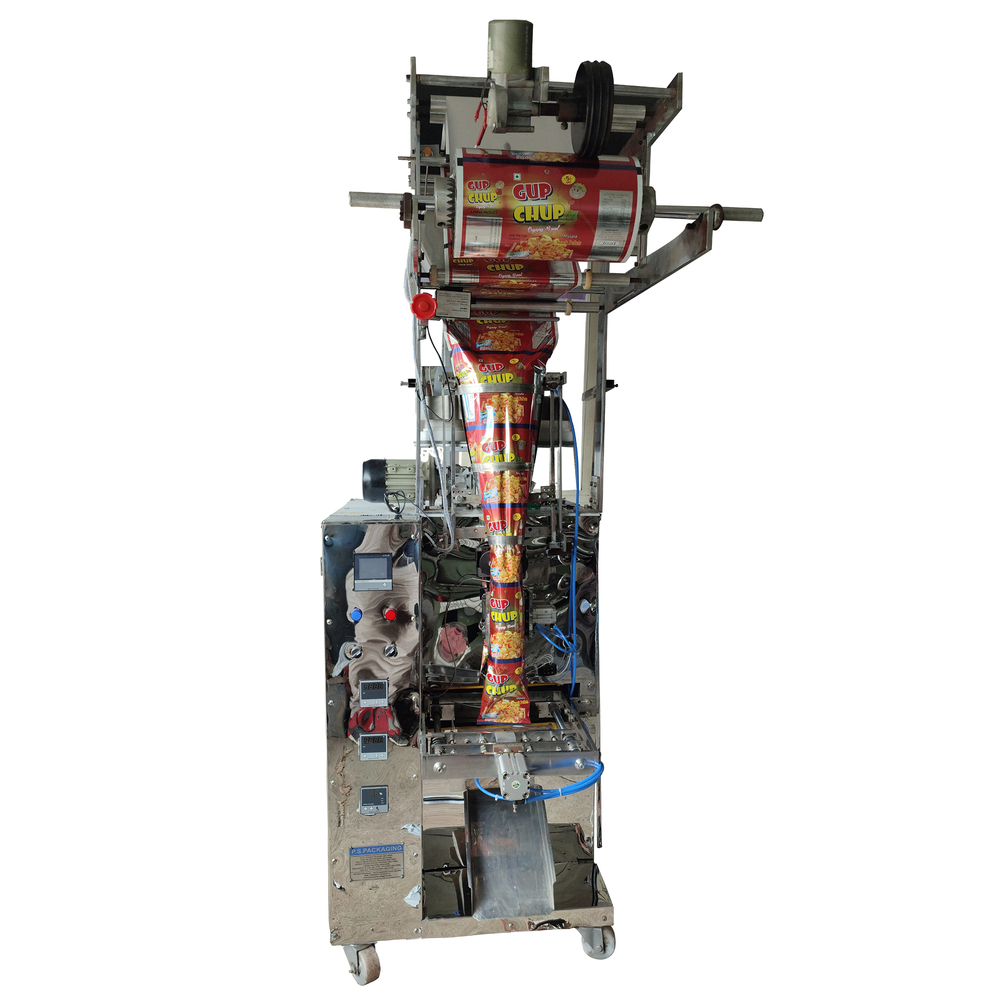 | Industrial Packaging Machine Pneumatic Cup Filler Packing Machine Manufacturer & Supplier in Indore | Patna | Nagpur -PS Packaging The Pnematic Cup Filler Packing Machine from PS Packaging, Indore, Madhya Pradesh is... View product → |
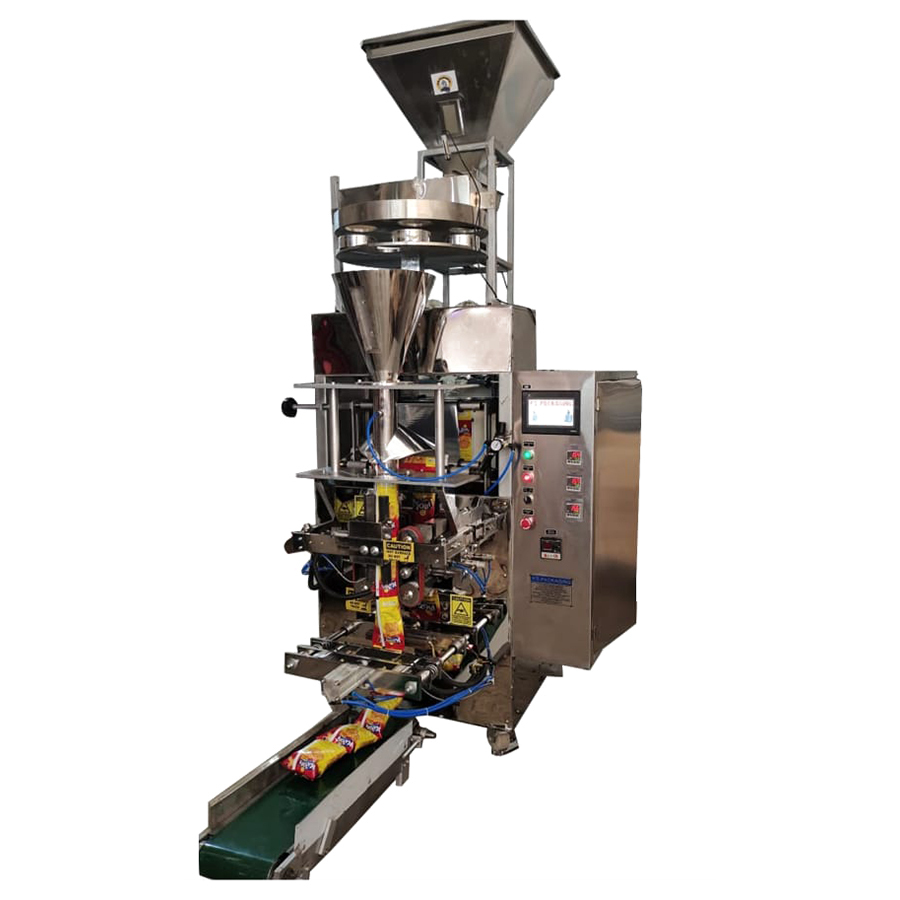 | Industrial Packaging Machine Collar Type Cup Filler Packing Machine The Collar Type Cup Filler Packing Machine is a robust and efficient packaging solution designed to deliver accurate filling and reliable sealing for... View product → |
Frequently asked questions
How does a pneumatic cup filler measure namkeen?
It measures namkeen by volume. Adjustable cups beneath the hopper fill to a set level, then a pneumatic gate releases the portion into the pouch.
How do you set a pneumatic cup filler for a target pack weight?
Run repeated tests with the actual namkeen, weigh each pouch, adjust the cup volume, and record the setting that produces the required average weight and acceptable variation.
How does cup filling compare with auger, single-head, multihead, and manual packing?
Cup filling suits free-flowing products with reasonably consistent bulk density. Augers suit powders, multihead weighers improve accuracy for irregular pieces, single-head systems suit lower output, and manual packing offers low equipment cost but higher labour and variation.
What pneumatic cup filler machine specifications should you check?
Check the required compressed-air pressure and consumption, filling range, pouch dimensions, output, sealing temperature controls, food-contact materials, electrical supply, changeover time, and included tooling.
How should you evaluate a namkeen packing machine manufacturer in Indore?
Take your actual namkeen and packaging film for a product trial. Check pack weight variation, seal strength, leakage, speed, changeover, air demand, operator steps, service access, and the complete delivered price.