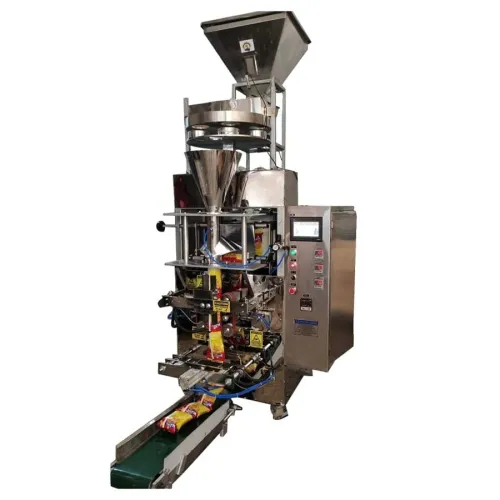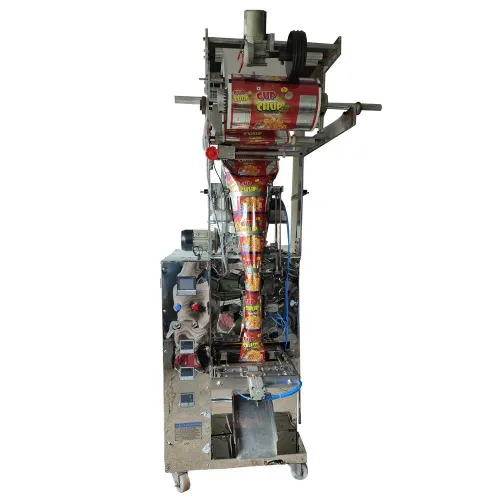


Loose chips must be fed gently, weighed within a defined tolerance, dropped into a correctly formed pouch, and sealed without trapping product in the seal. By following the machine sequence and comparing its weighing, feeding and sealing limits with your output target, you can specify the right equipment and request a useful quotation.
Key takeaways
- Four heads means four weighing hoppers combining portions into one target load.
- Use gentle feeding and vibration settings to protect fragile, irregular chips.
- Choose four, 10 or 14 heads by target weight, speed and product flow.
- Check film registration, seal temperature, pouch weight and seal integrity each run.
What “four heads” means in a chips packing machine
Four heads means four weighing hoppers, not four independent filling lanes. In a chips packing machine, each hopper receives a portion of product, weighs it, and opens at the right moment to release a combined target load.
A typical configuration links an infeed elevator, a distribution hopper, a four-head multihead weigher, and a vertical form-fill-seal unit. The elevator raises loose chips into the machine; the distribution system spreads them across the four weighing hoppers. The control system selects the hopper combination closest to the programmed pack weight.
1. Chips enter the upper feed hopper and move towards the four weighing heads through controlled vibration or gates.
2. Each head weighs its portion. The controller combines suitable portions instead of relying on one large scoop.
3. Selected hoppers discharge into the forming tube, where a flat film web has been shaped into a pouch around the tube.
4. The lower seal closes the filled pouch, the cross-seal jaws create the top of one pack and bottom of the next, and a cutter separates them.
This arrangement is one food packaging machine with linked stages, not four machines working side by side. A four-head model has fewer combinations and less buffering than a 10- or 14-head weigher, so output and weight optimisation depend on the chips, pack size, and feed settings.
A search for “chips packing machine four head in Nagpur” is only a starting point; request those operating details before comparing machines.
The complete weighing, pouch-forming and sealing sequence
Loose chips enter the machine through an infeed elevator and collect in the upper supply hopper. In a 4 head packing machine, the product is distributed to four weighing hoppers, not four independent packing lines.
1. A controlled vibratory or volumetric feed moves chips from the supply hopper toward the four weighing heads. Feed amplitude and gate timing must prevent unstable flow and broken chips.
2. Each weighing hopper receives a portion. The controller combines hopper weights to reach the target pack weight while limiting giveaway.
3. Once the combination is ready, the selected hoppers open together and discharge the weighed chips into the centre of the forming tube.
4. At the same time, the automatic filling machine draws laminated film from a roll and guides it around a forming collar. The film edges meet and receive a continuous longitudinal seal.
5. The filled film tube moves downward. The machine creates the bottom transverse seal for one pouch and the top seal for the preceding pouch.
6. A knife cuts between those seals, separating the finished pouch from the film web. The pack then drops onto a discharge conveyor for inspection or cartoning.
The chips must clear the sealing zone before the jaws close. Poor timing traps product in the seal, causing leaks, weak joints and rejected packs. A chips packing machine can add nitrogen flushing before the top seal when the product and film specification call for reduced oxygen exposure.
How chip characteristics affect feeding and weighing
Chip size distribution, density, fragility and flowability determine whether four-head dosing stays accurate without crushing the product. A chips packing machine must receive a steady layer from its vibratory or volumetric feeder; erratic flow leaves some weighing hoppers short and forces the automatic filling machine to add product late.
| Product property | Effect on weighing and handling | What to check or adjust |
|---|---|---|
| Chip size and thickness | Mixed sizes settle differently, causing weight variation and bridging at the feed gates. | Test the actual size range; set gate opening and vibration for the smallest and largest pieces. |
| Density and bulk volume | A light, bulky chip fills a hopper before reaching its target weight, while dense chips can overload it quickly. | Confirm bulk density and target pack weight; check hopper capacity before ordering. |
| Fragility and breakage | Excessive vibration, drop height or discharge speed creates crumbs and broken chips. | Reduce feed amplitude, shorten drops and use a gentle discharge setting during trials. |
| Oil, seasoning and moisture | Sticky surfaces make chips cling to contact parts; moisture changes flow and bulk density. | Check product temperature, seasoning load and cleaning access under production conditions. |
| Flowability | Poorly flowing product causes surging, bridging and unstable readings; very free-flowing chips increase giveaway. | Tune feed timing and amplitude, then measure repeatability and giveaway across a full run. |
Food-contact surfaces on the food packaging machine need smooth, accessible construction without crevices that trap oil or seasoning. Approve settings only after checking sealed-pack weight, breakage rate and underweight rejects, not speed alone.
Four heads versus 10 or 14: matching output to the product
A four-head weigher suits a chips line when the required saleable output fits its four-hopper combination range and the product feeds consistently.
It is a sensible choice for a smaller target, limited floor space, or a budget below a 10- or 14-head installation; it becomes restrictive when large packs, fragile chips, unstable feeding, or high bag-per-minute targets demand more combinations and buffer capacity.
| Configuration | Output and weighing effect | Best fit |
|---|---|---|
| Four heads | Fewer combinations and less buffering; lower throughput when packs are large or feeding is uneven | Moderate output, stable chips, limited space |
| 10 heads | More combinations improve weight optimisation and reduce waiting between discharges | Higher output or wider pack-weight range |
| 14 heads | Greatest combination flexibility and buffering, with more equipment, space and cleaning work | High throughput and demanding production schedules |
Do not treat “chips packing machine four head in nagpur” as a specification. Before requesting a quotation for a 4 head packing machine, give PS PACKAGING the following details:
- Chip type, shape, seasoning, breakage tolerance and bulk density
- Target pack weights, acceptable giveaway and required saleable bags per minute
- Product trial samples and preferred feed method, such as vibratory or volumetric dosing
- Film material, laminate structure, roll width, pouch dimensions and nitrogen-flushing requirement
- Available electrical supply, compressed-air pressure, floor space and ceiling height
- Cleaning access, food-contact material requirements and expected local service response
Ask for a product-specific acceptance test that records speed, giveaway, broken chips, rejected packs and seal quality. Nominal speed alone is not saleable output.
Related product
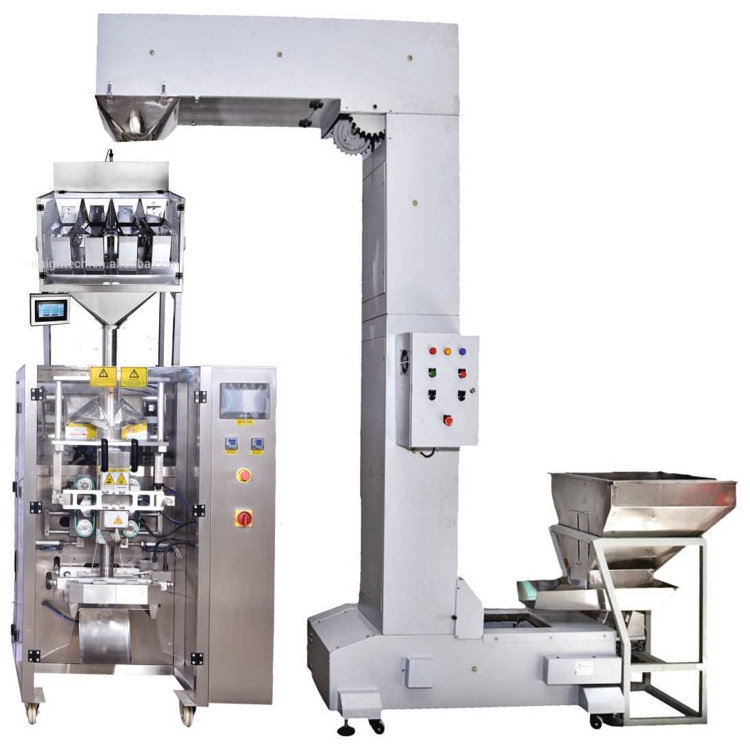 | 4 Head Packing Machine 4 Head Collar Type Packing Machine Manufacturer in Indore, India High-Speed Automatic 4 Head Collar Type Packing Machine by P.S. View product → |
Operator settings, film registration and finished-pack checks
Before restarting a chips packing machine, set the target weight, bag length, feed amplitude, feed-gate opening, discharge timing, sealing temperature, dwell time and jaw pressure for the approved product and film. Record the settings so a later shift does not rely on guesswork.
1. Check that the film roll is centred, the printed eye mark is visible, and the photoelectric registration sensor reads it consistently. Confirm film width, forming-collar alignment and bag length; poor tracking shifts graphics and creates uneven seals.
2. Inspect the forming tube, sealing jaws, cutter and discharge chute. Remove oil, crumbs and trapped chips, then confirm that the jaws close squarely and the cutter is sharp. A dirty jaw can produce a weak seal even at the correct temperature.
3. Run trial pouches before releasing the line. Verify net weight, average quantity and permitted deficiency under the Legal Metrology requirements applying to the product and pack format. Excessive giveaway increases cost; aggressive reduction creates underweight packs.
4. Examine the top, bottom and longitudinal seals for wrinkles, burn-through, open corners and product trapped across the seal. Check for leaks by gentle handling, and confirm date code, batch number, pouch appearance and count.
5. Restart only after the automatic filling machine or semi-automatic food packaging machine produces consecutive acceptable packs. Recheck weight, registration and seal quality after any film change, feed adjustment or stoppage.
Frequently asked questions
What does four heads mean in a chips packing machine?
Four heads means the machine has four weighing hoppers. Each hopper weighs a portion of chips, and selected hoppers discharge together to reach the target pack weight.
How does a four-head chips packing machine form and seal pouches?
The machine feeds chips into the weighing hoppers, combines portions, forms film around a pouch tube, drops the weighed load, and seals and cuts the pouch.
How do chip characteristics affect weighing and feeding?
Chip size, breakage, oil, seasoning, density and irregular shape affect vibration, feed speed and weighing accuracy. Set the feeder gently enough to limit breakage while maintaining the required rate.
Should you choose four heads, 10 heads or 14 heads?
Choose the number of heads by target pack weight, product flow, required output and available space. More heads offer more combinations for high-speed weighing, while four heads suit lower output and simpler lines.
What checks should operators make on finished packs?
Check target weight, film registration, pouch dimensions, seal temperature, seal pressure, cut position, leaks, wrinkles and product trapped in the seal.