
Choosing the right filler for spices depends on powder behaviour, pouch format, target weight, sealing conditions and the meaning of “pneumatic” in the machine specification. By the end, you will be able to compare filling systems, define a testable specification and plan commissioning for actual spice blends and film.
Key takeaways
- Test spice flow and bulk density before selecting the filler.
- Recalibrate when grinding, moisture or aeration changes.
- Match screw design, pouch dimensions, film and seal temperature.
- Demand weight checks, trial packs and documented commissioning results.
Which spices suit a pneumatic auger filler, and how does the machine work?
Turmeric, chilli powder, coriander powder, cumin powder, garam masala and blended masalas suit a pneumatic auger filler when their flow and bulk density are tested. An auger meters volume, not mass, so changes in grinding, moisture or aeration can change pouch weight.
| Product | Suitability | Extra check |
|---|---|---|
| Turmeric powder | Good for auger dosing | Check bridging and dust |
| Chilli powder | Good for auger dosing | Test flow and seal contamination |
| Coriander or cumin powder | Usually suitable | Check particle-size variation |
| Garam masala or blended masala | Suitable after trials | Check aroma retention and segregation |
| Coarse spice mixes | Requires product-specific testing | Confirm particles do not jam the screw |
| Oily or moisture-sensitive powders | Requires additional testing | Check caking, torque and feed consistency |
Fine chilli, turmeric and blended masala can bridge above the screw or form a rat-hole, leaving the hopper outlet starved. An agitator, suitable hopper geometry, vibration and controlled refill improve feeding, but excessive agitation aerates the powder and changes its bulk density.
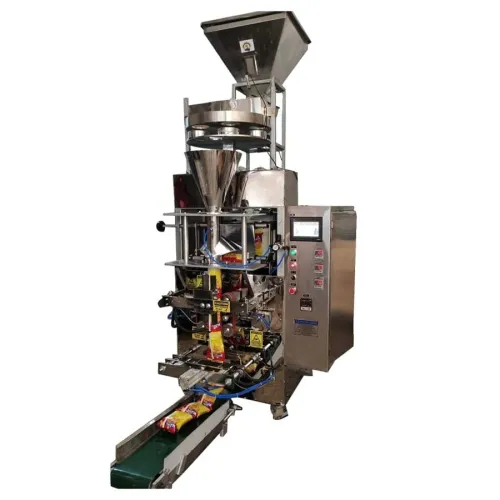
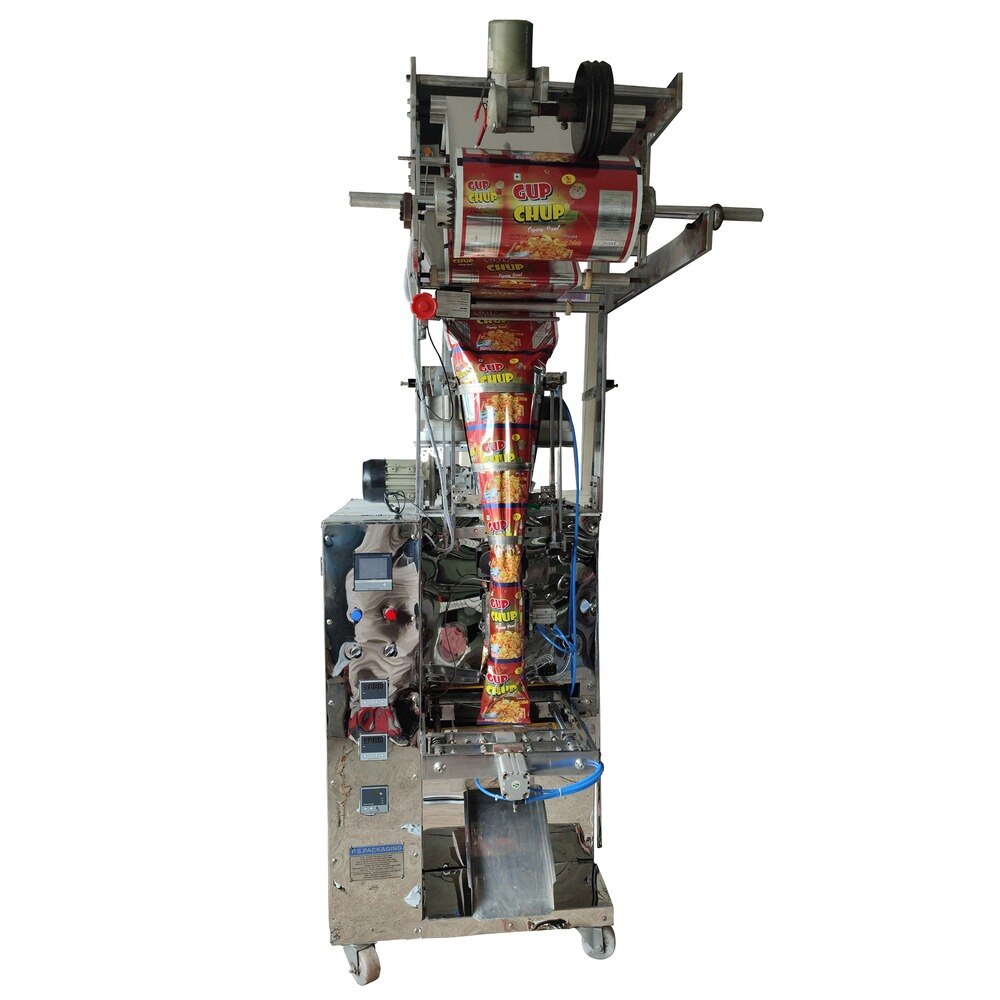
A spice pouch packing machine usually operates in this sequence:
- Load powder into the hopper; the agitator keeps material moving toward the outlet.
- The rotating screw flight carries a measured volume through the dosing tube.
- Pneumatic controls operate clamps, gates or filling-head movement; the auger itself may use a geared or servo motor.
- The vertical form-fill-seal unit forms film around the tube and receives the dose.
- Heat-sealing jaws close the pouch, cut or separate it, and discharge the finished pack.
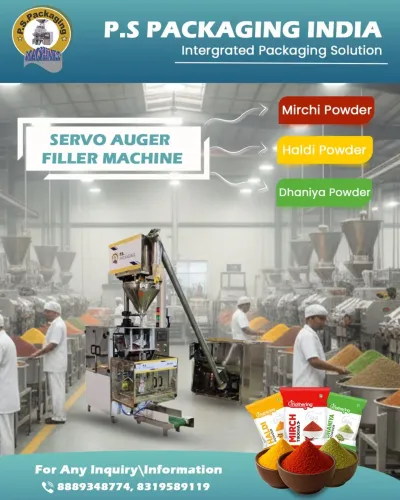
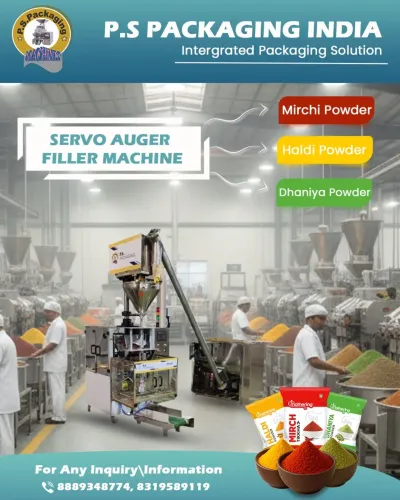
This packaging machine for spices needs its auger, tube, forming collar and jaws matched to the pouch size and powder volume.
How should you compare pneumatic, servo, cup, volumetric and multihead filling?
“Pneumatic auger” does not necessarily mean compressed air rotates the dosing screw. In a quoted auger filler machine, ask whether the auger uses a servo motor or geared motor, then identify what the air operates: pouch clamps, gates, filling-head movement or sealing actions.
The auger meters volume, not mass, so bulk-density changes still affect net weight.
| Option | Dosing principle | Main advantage | Main limitation |
|---|---|---|---|
| Pneumatic auger | Rotating screw with pneumatic auxiliary actions | Suits powders and supports simple automation | “Pneumatic” may hide the actual dosing motor and air requirement |
| Servo auger | Servo-controlled screw revolutions | Precise recipes, speed control and easier adjustment across weights | Costs more and still requires density-based calibration |
| Cup filling | Fixed or adjustable cups discharge a set volume | Fast for free-flowing, consistent granules | Poorer fit for cohesive, aerated or variable-density spice powders |
| Volumetric filling | Measures a repeatable volume using cups, augers or chambers | Simple, productive and economical | It is not gravimetric; mass changes when density changes |
| Multihead weighing | Weighs portions through multiple hoppers before discharge | Best gravimetric control and flexible target weights | Higher cost, footprint and complexity; powder handling can slow operation |
Choose auger dosing for turmeric, chilli, coriander, cumin and blended masalas after testing flow and density. Choose multihead weighing when weight control outweighs speed or when the product is coarse and inconsistent.
Do not compare a vertical form-fill-seal spice pouch packing machine with a premade-pouch filler using quoted speeds alone. VFFS forms rollstock and seals it; premade equipment feeds, opens and presents finished pouches. Their changeover tasks, pouch formats and output claims are different.
How do bulk density, screw design and calibration determine pouch weight?
A fixed auger volume does not deliver a fixed mass. Grinding changes particle-size distribution; blending and settling alter packing; moisture and oil increase cohesion; hopper aeration lowers bulk density. Fine turmeric, chilli and masala can bridge or rat-hole, while excessive agitation aerates the powder and makes each screw revolution lighter.
An auger filler machine therefore needs product trials, not a generic accuracy claim.
Select the powder filling machine against:
- Screw diameter and pitch matched to bulk density, target dose and dosing range
- Hopper geometry that limits dead zones, with an agitator suited to cohesion
- Filling head and tube that prevent dust escape and pouch fouling
- Agitation strong enough to prevent bridging, but gentle enough to avoid aeration
- Separate screws or recipes when minimum, nominal and maximum weights differ sharply
Use this operating procedure:
- Load a settled, representative spice lot and record its condition; refill the hopper through a controlled quantity and rate.
- Run trial fills at minimum, nominal and maximum weights, then calibrate auger revolutions against collected mass.
- After start-up and each hopper refill, check a recorded sample on a calibrated balance.
- Define the target weight and tolerance before testing; choose balance resolution smaller than the allowed variation.
- Retain every individual result, plus mean, lightest pack, heaviest pack and each adjustment. Accept the setting only when all three weight ranges meet the defined tolerance.
How should you choose film, pouch dimensions and sealing controls for spices?
A powdered spice laminate must protect against moisture, oxygen, light and aroma loss while sealing cleanly. Compare structures such as PET/PE, PET/metallised PET/PE or other food-contact laminates with the film supplier; select the barrier from the spice’s sensitivity, shelf-life target and sealing window, not from appearance alone.
Pouch width and length determine the forming collar, auger tube, dosing head and sealing-jaw size. A 10 g sachet and a 500 g pouch can require different collars, tube diameters, augers and jaw dwell settings. Do not treat the larger pack as only a recipe change.
| Format | Suitable use | Main requirement |
|---|---|---|
| Centre-seal pillow pouch | Small and medium spice packs | Correct collar width, longitudinal seal overlap and clean cross-seals |
| Gusseted centre-seal pouch | Larger volume or greater standing capacity | Gusset former, wider film path and adequate jaw travel |
| Three-side or premade pouch | Retail formats needing a separate pouch | Pouch opening, presentation and sealing equipment matched to the pouch |
Set seal temperature, dwell time and jaw pressure through trials on the chosen laminate and actual spice lot. Copying values from another film can produce brittle seals, incomplete fusion or scorched edges.
Control powder in the seal area by using:
- A nozzle positioned above the seal zone, with a close-fitting tube.
- A short settling interval or dust-removal step before jaw closure.
- Extraction or an enclosure at the filling point.
- Jaws that operators can reach and clean without difficult dismantling.
- Seal-strength testing and leak testing after start-up, refill and film changes.
A spice pouch packing machine should record these settings for each pouch format; a packaging machine for spices that lacks change-part identification will make repeatable changeovers difficult.
What should you demand during commissioning of a Nagpur spice packing machine?
Demand a signed commissioning protocol for the spice pouch packing machine pneumatic auger filler in Nagpur, not a nominal accuracy claim. The protocol must name the spice, pouch size, target weight, film laminate, speed, utility limits and pass/fail criteria.
PS PACKAGING can support this as a Nagpur-based supplier, but you should request evidence from your own products and conditions.
1. Inspect every product-contact part: hopper, auger, nozzle and chute. Specify food-suitable, corrosion-resistant material and finish, with tool-less dismantling, smooth surfaces and no inaccessible dead spaces.
2. Require dust control at the filling point through a close-fitting nozzle, extraction connection or enclosure. Ask how operators will clean collected spice dust and prevent contamination or combustible-dust accumulation.
3. Record compressed-air pressure, flow, dew point and filtration against ISO 8573-1 classes for particles, water and oil. Wet or oily air can stick valves, contaminate seals and cause irregular pneumatic motion.
4. Verify guarding through an ISO 12100 risk assessment covering auger access, film pulling, sealing jaws, jam clearing, unexpected restart and stored pneumatic energy. Require isolation and pressure-release instructions before cleaning or maintenance.
5. Run turmeric, chilli and aromatic-blend changeovers. Validate dry or wet cleaning limits, auger removal, inspection points and carry-over results before approving production.
6. Trial the powder filling machine at seasonal temperature and humidity extremes, especially Nagpur’s monsoon conditions. Record caking, bridging, torque, seal contamination and dust; test dehumidification before increasing auger speed.
7. Approve net content using a calibrated checkweigher or balance. Define sample size and frequency after start-up and hopper refill, then retain each result, mean, minimum, maximum and adjustment in the acceptance record.
Related product
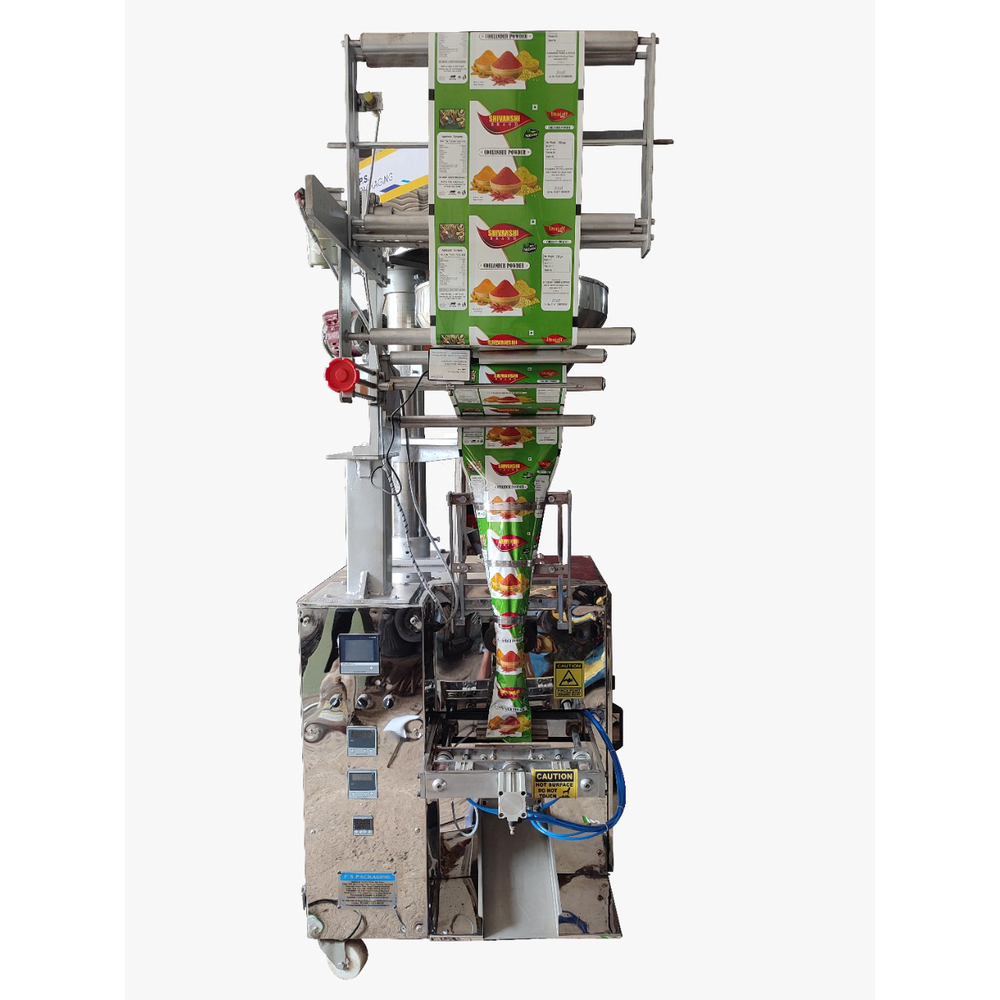 | Industrial Packaging Machine Pneumatic Auger Filler Packing Machine Manufacturer & Supplier in Indore | PS Packaging The Pneumatic Auger Filler Packing Machine from PS Packaging, Indore, Madhya Pradesh is a reliable... View product → |
Frequently asked questions
Which spices suit a pneumatic auger filler?
Turmeric, chilli powder, coriander powder, cumin powder, garam masala and blended masalas suit an auger filler when their flow and bulk density are tested.
How does a pneumatic auger filler determine pouch weight?
The auger meters a measured volume of powder, so bulk density, screw design and calibration determine the resulting pouch weight.
How should you compare auger, servo, cup, volumetric and multihead filling?
Compare each system by powder flow, target weight, accuracy, product handling, speed, changeover effort and the cost of overfill.
What should you check when choosing spice pouch film and seals?
Check film barrier needs, pouch dimensions, product dust, seal-jaw temperature, dwell time and seal pressure through trial packs.
What should commissioning include for a Nagpur spice packing machine?
Request trial runs at target speeds, repeated weight checks, seal inspection, changeover demonstrations, cleaning instructions and documented acceptance results.